
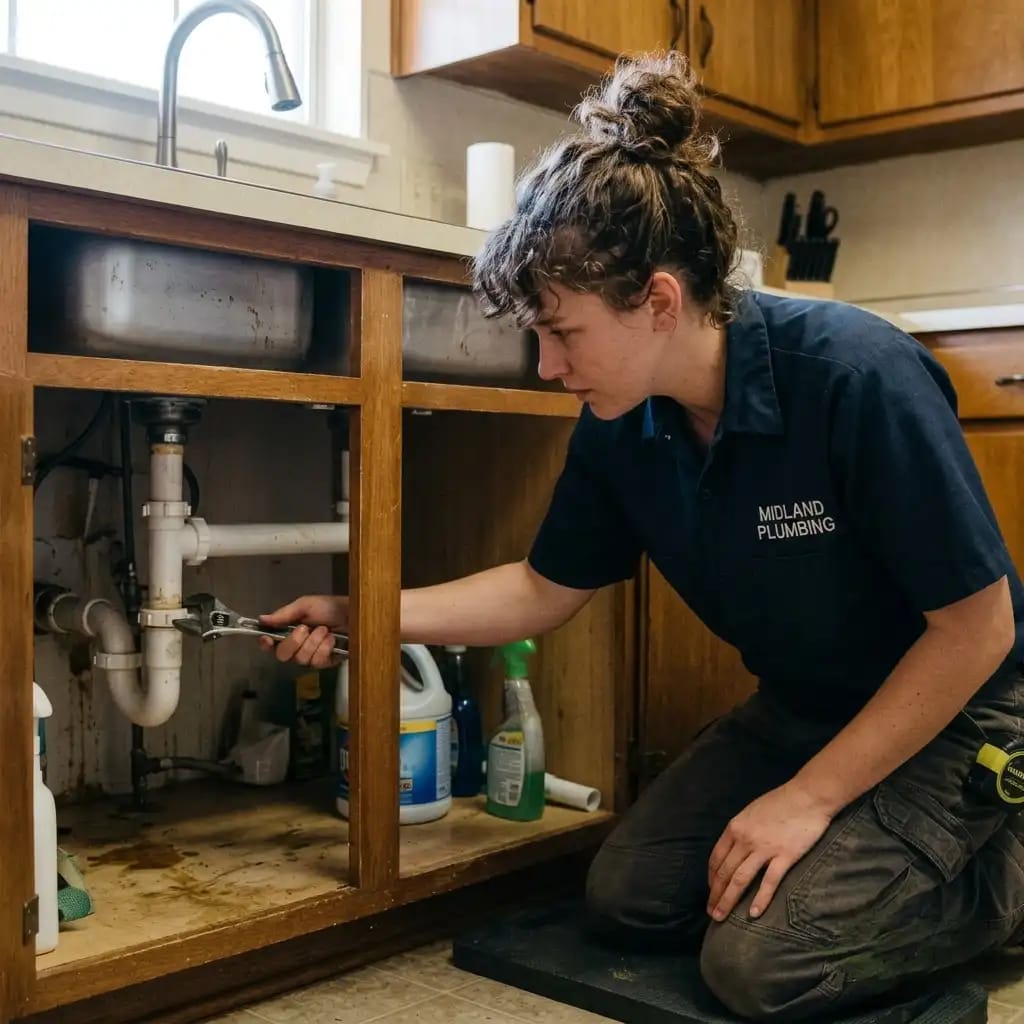
In Brief
Midland homeowners deal with a specific mix of plumbing stress: very hard municipal water (400-600 ppm) that scales up water heaters and fixtures, occasional hard freezes that put exposed and poorly insulated pipes at risk, and ageing plumbing in the city’s older neighbourhoods. Most day to day issues, such as a running toilet, a slow drain, or a dripping faucet, are safe, low cost fixes. Anything involving your main water line, gas line, sewer line, or a suspected slab leak calls for a licensed Texas plumber, both for safety and because unlicensed work isn’t legal for anyone other than the homeowner on their own primary residence.
Introduction
If you’ve lived in Midland for more than a summer or two, you already know this isn’t gentle water. It leaves a chalky ring on your shower door within a week of cleaning it, it eats through faucet aerators, and it makes your water heater work harder than it should. Add in a housing stock that ranges from 1950s downtown homes to brand new builds off Loop 250, plus the occasional deep freeze that catches everyone off guard, and you get a pretty distinct set of plumbing problems compared to, say, Houston or Dallas.
I wrote this guide the way I’d walk a neighbour through their own house: what’s actually going wrong, why it happens here specifically, what you can safely handle yourself, and where it’s genuinely time to pick up the phone. I’m not going to hand you made up prices or invent “average repair costs,” because nobody can honestly give you that without seeing your house. What I can give you is a clear, honest framework so you’re not guessing.
Key Takeaways
- Midland’s water is documented as very hard (400–600 ppm) by the City of Midland, which explains a large share of local water heater, fixture, and appliance problems.
- The EPA estimates the average home wastes 9,000–10,000+ gallons a year to leaks that are often simple DIY fixes, like a worn toilet flapper.
- Frozen or burst pipes are a real statewide risk in Texas, even though hard freezes are infrequent homes here often aren’t built for the cold the way northern homes are.
- Texas requires plumbing work to be done by a licensed plumber regulated by the Texas State Board of Plumbing Examiners (TSBPE), with limited exceptions for homeowners working on their own primary residence.
- Reliable, current repair pricing for your specific situation should come from a written, in-home estimate not a generic number online.
Table of Contents
- Why Midland’s Water and Climate Shape Local Plumbing Problems
- Leaks: The Most Common (and Most Ignored) Plumbing Problem
- Drain Clogs and Slow Drains
- Plumbing Problems Midland TX
- Water Heater Issues
- Hard Water, Mineral Buildup, and Pipe Corrosion
- Water Pressure Problems
- Frozen and Burst Pipes
- Sewer Line Issues
- Repiping: When Replacement Beats Repair
- Preventive Maintenance Checklist
- DIY vs. Professional: How to Decide
- When to Call a Local Plumber Immediately
- FAQ
Two Hours and Climate Shape Local Plumbing Problems
Midland’s plumbing problems are shaped mainly by two documented local factors: very hard municipal water (400-600 ppm, per the City of Midland) that accelerates scale buildup, and occasional severe winter cold that stresses pipes not built for it. Understanding these two forces explains why the same fixture might fail here years before it would in a softer water, milder winter city.
The City of Midland’s own water quality FAQ puts local hardness at 400-600 parts per million. To put that in context, water above roughly 180 ppm is generally considered “very hard.” That mineral load, mostly calcium and magnesium, doesn’t just affect how your soap lathers. It deposits inside pipes, water heater tanks, and fixture cartridges over years, narrowing flow and making moving parts stick or wear out early.
On the climate side, Midland doesn’t see hard freezes every winter, but Texas as a whole has shown it can happen fast and hard. The February 2021 statewide freeze event is the clearest example, with sustained sub freezing temperatures triggering burst pipes and boil water notices across nearly the entire state. Homes here, like most in Texas, often route pipes through exterior walls or unconditioned spaces because the state doesn’t typically require the deep, insulated placement common in northern climates. That combination of infrequent but severe cold, plus construction built for typical Texas winters, is what makes freeze prevention worth taking seriously even in a place that’s warm most of the year.
Leaks: The Most Common (and Most Ignored) Plumbing Problem
Quick answer: The EPA estimates the average U.S. household loses more than 9,000-10,000 gallons of water a year to leaks, most commonly worn toilet flappers, dripping faucets, and leaking showerheads. Many of these are safe, inexpensive DIY fixes; a leak you can’t locate, or one near electrical wiring or your foundation, is not.
Causes
- Worn rubber components (toilet flappers, faucet washers, O-rings). WaterSense recommends replacing toilet flappers roughly every five years.
- Mineral buildup that prevents fixtures from sealing fully, which is more common in Midland’s hard water than in soft-water cities.
- Loose or corroded supply-line connections under sinks and behind appliances.
- Pipe joints stressed by ground movement, freeze-thaw cycles, or age.
Warning Signs
- A water bill that jumps without a clear reason.
- The sound of running water when every fixture is off.
- Damp cabinets, warped flooring, or a musty smell near a fixture.
- A water meter that keeps moving during a two-hour period when nothing in the house is using water.
DIY vs. Professional
Fixing a running toilet, a dripping faucet, or a leaking showerhead is a reasonable weekend project for most homeowners. Parts are inexpensive, and the risk of making things worse is low. A leak you’re discoloured but can’t find, discoloured your electrical panel, or a priority that seems to be coming from under your slab is a different situation. At that point, a plumber with acoustic or thermal leak-detection equipment can find the source and determine the necessary demolition.
Drain Clogs and Slow Drains
Quick answer: Most drain clogs come from hair, grease, soap scum, and mineral buildup narrowing the pipe over time. Single fixture clogs are usually DIY friendly; a clog that affects multiple drains at once, or keeps coming back after cleaning, points to a deeper line problem that needs a professional camera inspection.
Causes
- Hair and soap scum in bathroom drains.
- Grease and food debris grease solidifies as it cools and narrowspublicly defensible.
- Mineral scale narrowing pipe diameter in hard-water areas like Midland.
- Tree root intrusion in older sewer laterals.
DIY vs. Professional
A slow single sink or tub drain often responds to a drain snake or a plunger skip chemical drain cleaners where you can, since repeated use can damage older pipe and doesn’t address the underlying buildup. If more than one fixture is clogged for two hours, or a plunger and snake aren’t clearing it, that’s a sign the blockage is further down the line and worth a professional camera inspection rather than repeated DIY attempts.
Toilet Problems
Quick answer: Running toilets, weak flushes, and rocking toilets are the most common complaints, and most trace back to a worn flapper, a misadjusted fill valve, or a failed wax ring seal. These are typically DIY-fixable; a toilet that’s leaking at its base onto the floor should be treated as a plumbing call, since it can point to a failed course seal and hidden subfloor damage.
- Running constantly: usually a worn flapper or fill valve, a low-cost, DIY-friendly repair.
- Weak or incomplete flush: often mineral buildup restricting the rim, the jets or the trapway, again more common with Midland’s hard water.
- Rocking or unstable toilet: can mean a failed wax ring, galvanised only, or a cracked flange worth professional attention since a bad seal can leak into the subfloor unnoticed.
- Frequent clogs: may be a low-flow toilet mismatched to your plumbing, a partial line blockage, or foreign objects in the trap.
Water Heater Issues
Quick answer: In hard water cities like Midland, sediment and mineral scale are the leading cause of early water heater failure; they reduce efficiency and cause ageing galvanised popping or rumbling noises, shortening tank life. Annual planning is the single most effective preventive step, and any gas smell, water pooling at the base, or no hot water at all warrants a professional visit.
Causes
- Sediment and scale accumulating at the bottom of the tank, insulating the burner or element from the water and forcing it to work harder.
- Anode rod depletion, which accelerates tank corrosion once it’s fully consumed.
- Thermostat or heating element failure.
- Pressure relief valve issues, which are a safety component and not something to ignore.
Warning Signs
- Popping, rumbling, or cracking sounds usually sediment shifting under the burner.
- Rusty or discolored hot water.
- Water pooling at the base of the tank.
- A noticeable drop in hot water volume or how long it lasts.
Repair vs. Replace
A single failed component, a thermostat, an element, or a relief valve, is usually worth repairing, especially on a newer unit. A tank that’s actively leaking from the tank body itself (not a fitting), or one that’s approaching or past its typical service life and showing multiple issues at once, is usually more cost effective to replace than to keep patching. A licensed plumber can flush and inspect the tank to tell you honestly which category you’re in.
Hard Water, Mineral Buildup, and Pipe Corrosion
Midland’s water hardness is officially documented at 400-600 ppm by the City of Midland, among the harder municipal water supplies in the country. Over the years, that mineral load builds scale inside pipes and appliances, restricts flow, and can accelerate corrosion in certain metal piping. A whole-home water softener is the standard professional recommendation for hardness at this level.
Signs of hard water damage include white or chalky buildup on faucets and shower heads, reduced water pressure over time, spotty dishes and glassware, and appliances (dishwashers, washing machines, water heaters) needing repair or replacement earlier than their rated lifespan. None of this is unique to any one house; it’s a citywide water chemistry issue, which is why so many Midland homes eventually add treatment.
PEX vs. Copper vs. CPVC: Pipe Material Comparison
Reported lifespans vary meaningfully across manufacturer and industry sources depending on water chemistry, installation quality, and pipe thickness, so treat the ranges below as general industry guidance, not a guarantee for any specific home.
| Material | Typical Lifespan (industry-reported range) | Flexibility / Freeze Tolerance | Best Fit |
|---|---|---|---|
| PEX | 40-50+ years | Flexible; expands slightly under freeze pressure, which can reduce (not eliminate) burst risk | Repipes, tight spaces, homes with hard water where scale buildup is a concern |
| Copper | 50-80 years (varies with pipe thickness and water chemistry) | Rigid; can be prone to pinhole leaks in aggressive or very hard water over time | Exposed runs, homeowners prioritising a long standing, well documented track record |
| CPVC | 50-75 years (industry sources vary) | Rigid; can become brittle with age or extreme cold | Budget-conscious repiping where code allows and freeze exposure is limited |
Note: Lifespan figures above are a general industry range compiled from multiple manufacturer and trade sources; no single authoritative figure exists, and actual lifespan depends heavily on your specific water chemistry and installation. Ask your plumber which material fits your home’s situation.
Water Pressure Problems
Low water pressure is usually caused by mineral buildup narrowing pipes or clogging aerators, a partially closed shutoff valve, or a failing pressure regulator. High pressure which stresses fittings and can cause leaks over time is usually a pressure regulator issue and worth having tested.
- Low pressure at one fixture: usually a clogged aerator or cartridge, an easy DIY clean or replacement.
- Low pressure throughout the house: often points to scale buildup in supply lines or a failing pressure regulator worth a professional pressure test.
- Sudden pressure changes during peak use hours: can happen in newer or fast growing subdivisions where demand fluctuates usually a municipal supply issue rather than a home plumbing defect, though it’s worth confirming with a plumber.
- Unusually high pressure: can silently stress fittings and appliance connections; a pressure reducing valve is the standard fix.
Frozen and Burst Pipes
Texas homes are documented as more vulnerable to freeze damage than homes in colder climates, largely because pipes are often run through exterior walls and buried shallower, and because hard freezes are infrequent enough that many homes aren’t prepared. The statewide 2021 freeze event is the clearest evidence of how severe this risk can get.
Prevention
- Disconnect and drain outdoor hoses before the first hard freeze of the season.
- Let faucets fed by exposed or exterior-wall pipes drip during a hard freeze moving water is less likely to freeze solid.
- Open cabinet doors under sinks on exterior walls so warm household air can reach the pipes.
- Know where your main shutoff valve is before you need it in an emergency.
What to Do If a Pipe Freezes or Bursts
- Shut off the main water valve immediately if you suspect a frozen or burst pipe.
- Never use an open flame or direct heat source to thaw a pipe; this is a fire and safety hazard.
- Open the nearest faucet slightly to relieve pressure as a frozen line thaws.
- Call a licensed plumber right away if you see no water flow at all, or any sign of an active leak.
This sequence lines up with standard guidance from Texas plumbers and utility providers statewide the core idea is always the same: cut the water supply first, avoid open flame, relieve pressure, then get a professional assessment.
Sewer Line Issues
Quick answer: Recurring backups, gurgling drains, slow drainage throughout the house, or sewage odour in the yard usually point to a main sewer line problem rather than a single fixture clog. This is not a DIY repair it requires a camera inspection to identify the cause and location before any repair method is chosen.
- Grease, wipes, and debris buildup narrowing the line over years.
- Tree root intrusion, especially in older sewer laterals.
- Pipe misalignment or cracking from ground movement or age.
- Collapsed sections in very old clay or cast-iron lines.
Modern camera inspection lets a plumber see exactly what’s happening inside the line before recommending a fix. In many cases, hydro-jetting or trenchless repair can resolve the issue without excavating your yard; a collapsed or severely damaged section may still require digging. Either way, this is squarely professional only work; attempting it yourself risks worse damage and, in Texas, generally isn’t legal for anyone other than the homeowner on their own primary residence.
Repiping: When Replacement Beats Repair
Quick answer: Repiping usually becomes the smarter long term choice once a home has recurring leaks in multiple locations, visibly corroded or discoloured water, or an ageing galvanised steel pipe, rather than continuing to patch one failure point at a time. This is a licensed plumber’s decision, ideally supported by an in-home inspection.
Repair vs. Replace
| Situation | Usually Repair | Usually Replace / Repipe |
|---|---|---|
| Number of leak points | One isolated leak | Multiple leaks in different locations over a short period |
| Pipe material | Modern PEX, copper, or CPVC in good condition | Aging galvanized steel or heavily corroded copper |
| Water quality symptom | Occasional discoloration after work on the line | Chronic rusty or discolored water with no clear single cause |
| Water heater condition | Component failure (thermostat, element, valve) | Tank body leak or age, combined with multiple failures |
This is a judgment call that benefits from an in person inspection. A plumber can pressure test the system and visually assess pipe condition rather than guessing from symptoms alone.
Preventive Maintenance Checklist
Quick answer: A short list of seasonal habits, checking for leaks, flushing the water heater, testing for freeze readiness, and watching your water bill catches most plumbing problems while they’re still cheap and easy to fix.
- Check your water meter before and after a two hour period with no water use to test for hidden leaks (EPA WaterSense method).
- Replace toilet flappers roughly every five years, per WaterSense guidance, even if nothing seems wrong yet.
- Flush your water heater annually to clear sediment more important in Midland’s hard water than in soft-water cities.
- Clean faucet aerators and showerheads periodically to remove mineral buildup.
- Inspect exposed pipes and outdoor spigots before the first hard freeze each winter.
- Know the location of your main water shutoff valve before an emergency, not during one.
- Watch your water bill for unexplained increases, which can be the earliest sign of a hidden leak.
- Schedule a professional camera inspection of your sewer line if your home is older or you’ve had repeat backups.
DIY vs. Professional: How to Decide
| Factor | Lean DIY | Call a Licensed Plumber |
|---|---|---|
| Type of fixture | Toilet flapper, faucet aerator, showerhead | Water heater, gas line, main water line, sewer line |
| Visibility of the problem | You can see and reach the part that’s failing | The source is hidden (under a slab, in a wall, underground) |
| Tools required | Basic hand tools you already own | Camera inspection, leak detection, or pressure-testing equipment |
| Legal requirement | Homeowner working on their own primary residence | Any work beyond that generally requires a TSBPE-licensed plumber |
| Risk if done wrong | Low inexpensive part, easy to redo | High water damage, gas safety, code compliance, warranty issues |
When to Call a Local Plumber Immediately
Treat these as non negotiable professional calls, not weekend projects. The risk of property damage or personal safety is too high to guess.
- You smell gas anywhere near a gas line or water heater
- Leave the house and call from outside, then call your gas utility and a licensed plumber.
- You suspect a slab leak (warm spots on the floor, a rising water bill with no clear cause, the sound of running water when everything’s off).
- Sewage is backing up into a tub, shower, or floor drain.
- A pipe has burst and you can’t shut off the water yourself.
- You have no hot water at all, or you see standing water at the base of your water heater.
- Multiple drains in the house are backing up at the same time.
FAQ
How hard is Midland’s water, really?
The City of Midland publishes a hardness range of 400-600 parts per million, high enough that most local plumbers recommend a water softener for whole-home protection.
Do I need a permit to fix my own plumbing in Texas?
Texas allows homeowners to perform plumbing work on their own primary residence without a license, but the work still generally needs to pass inspection. Anyone else doing plumbing work for you must be licensed through the TSBPE.
How do I know if I have a slab leak?
Watch for unusually high water bills, warm spots on the floor, the sound of running water when everything is off, and damp or discoloured flooring. A plumber can confirm it with leak-detection equipment without unnecessary demolition.
Can a clogged sewer line be fixed without digging up my yard?
Often, yes. Camera inspection identifies the cause and location, and hydro jetting or trenchless repair can frequently clear or fix the line without excavation. A collapsed section may still require digging.
What should I do the moment I notice a frozen pipe?
Shut off your main water valve, avoid any open flame or direct heat to thaw it, open the nearest faucet slightly to relieve pressure, and call a licensed plumber if you see no water flow or any sign of a leak.
How often should I flush my water heater in Midland?
At least once a year is the general recommendation for homes on Midland’s hard water supply, since sediment accumulates faster here than in softer-water areas.